


| 2026 Incidents | |
| Jan | 17 |
| Feb | 13 |
| Mar | 12 |
| Apr | 17 |
| May | 21 |
| Jun | 16 |
| Jul | 25 |
| Aug | 18 |
| Sep | 19 |
| Oct | 10 |
| Nov | 0 |
| Dec | 0 |
| Total | 168 |
Since
May 21, 2026
Oct 12, 2026
Crisfield Volunteer Fire Department: A History of Service, Adaptation, and Community
Content provided by Phillip Goldsbourgh Fire Department Historian
The history of the Crisfield Volunteer Fire Department is deeply connected to the history of Crisfield itself. It is the story of a waterfront community that grew from the old Annemessex settlement into one of Maryland’s best-known Eastern Shore towns, and of citizens who organized, adapted, and served to protect their neighbors through fire, flood, rescue, and emergency response. From 96 feet of ladders and 50 buckets in 1874 to modern engines, tankers, aerial apparatus, rescue equipment, command vehicles, and marine-response capability, the department’s history reflects more than 150 years of changing risks, changing technology, and steady community commitment.
Early Crisfield and the Need for Fire Protection
Long before the organization of a fire company, the area that became Crisfield was known in early records as Annemessex. The region was shaped by water, agriculture, seafood, and transportation. Colonial settlement developed along the creeks, rivers, and roads that connected farms, landing points, and waterfront activity. For generations, homes and businesses faced the ever-present threat of fire without organized fire protection. In an era of open fireplaces, wood-frame buildings, oil lamps, stoves, and limited water supply, a serious fire often meant the loss of an entire structure.
The arrival of the railroad in the 1860s changed the community dramatically. Seafood and other goods could be shipped to northern markets, and businesses began to grow rapidly around the rail line and waterfront. Many structures were built of wood, placed close together, and often located in dense commercial areas near the tracks and docks. This growth brought prosperity, but it also created a dangerous fire problem. By the time Crisfield was incorporated in 1872, city leaders and local business owners recognized that the new town needed organized fire protection.
The Founding of Crisfield Fire Company No. 1
In November 1874, several concerned citizens met with the City Commissioners about organizing fire protection for Crisfield. City records show that 96 feet of ladders and 50 buckets were purchased, and the Crisfield Fire Company No. 1 was formed. It was a modest beginning, but it marked the start of organized fire service in the city.
The first company was essentially a bucket brigade. Members had no motorized apparatus, no radios, no hydrant system, no breathing apparatus, and no modern protective equipment. Their tools were simple: buckets, ladders, axes, hooks, wells, bells, horses, and manpower. In 1876, City Bailiff John E. N. Sterling was authorized to purchase 48 white-cedar buckets, six axes, and a 30-foot hook ladder. That same year, the city authorized the purchase of a bell from William T. Lawson to serve as a fire alarm. The bell was housed in a wooden enclosure, and authorized persons would ring it to alert the fire brigade. According to the department’s history, an individual on horseback would also ride through town blowing a horn and shouting “fire” to alert residents and members.
Around 1880, the city acquired a hand pumper and hose wagon to improve firefighting capability. The equipment was stored in Andrew Poleyette’s livery stable in the lower downtown section near present-day Ninth Street. Even with this improvement, the early company remained limited by manpower, weather, distance, and water supply. One remembered account describes members attempting to pull hand-drawn equipment through snow toward an uptown fire, only to make it about halfway before the house was lost.
The Great Fire of 1883 and the Steam Pumper Era
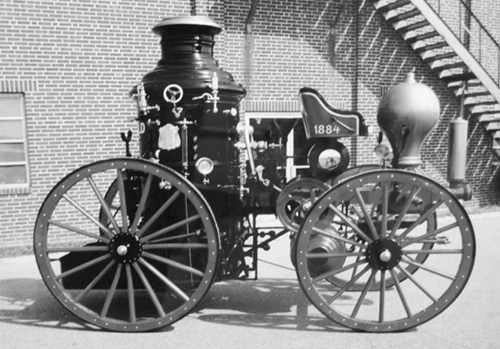
The limitations of the early bucket-brigade system became clear in 1883, when a large fire broke out in lower Crisfield. The department’s equipment and water supply were not sufficient to control the blaze, and many wooden structures on both sides of the railroad tracks were reportedly reduced to ashes. The fire was a major setback for the city’s growing economy, but it also led to one of the most important developments in the department’s history: the purchase of a horse-drawn steam pumper.
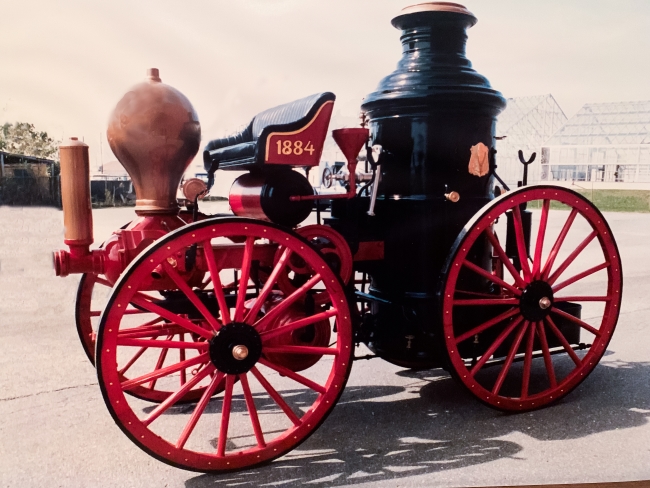
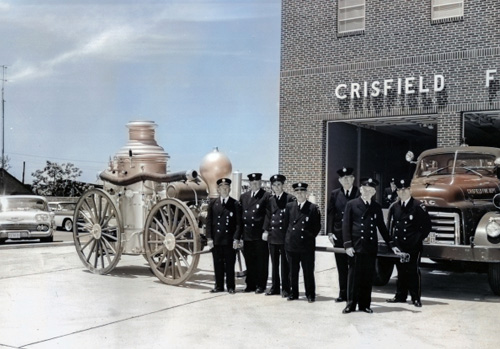
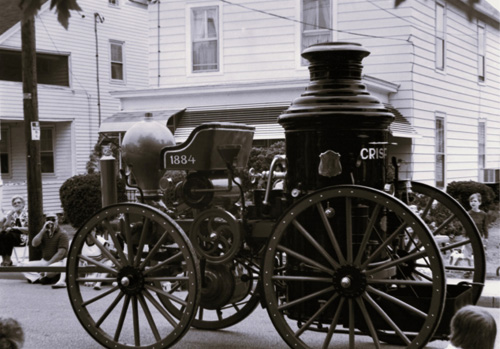
City records indicate that the steamer was purchased from the Clapp & Jones Manufacturing Company of Hudson, New York, for $2,800. It was equipped with a steam signal whistle, lanterns, name plate, tools, and accessories. The apparatus arrived by train at Pine Street Station and was placed into service in 1885. It represented a major advancement for Crisfield, giving the company the ability to move water with far greater force and reliability than buckets or hand pumps could provide.
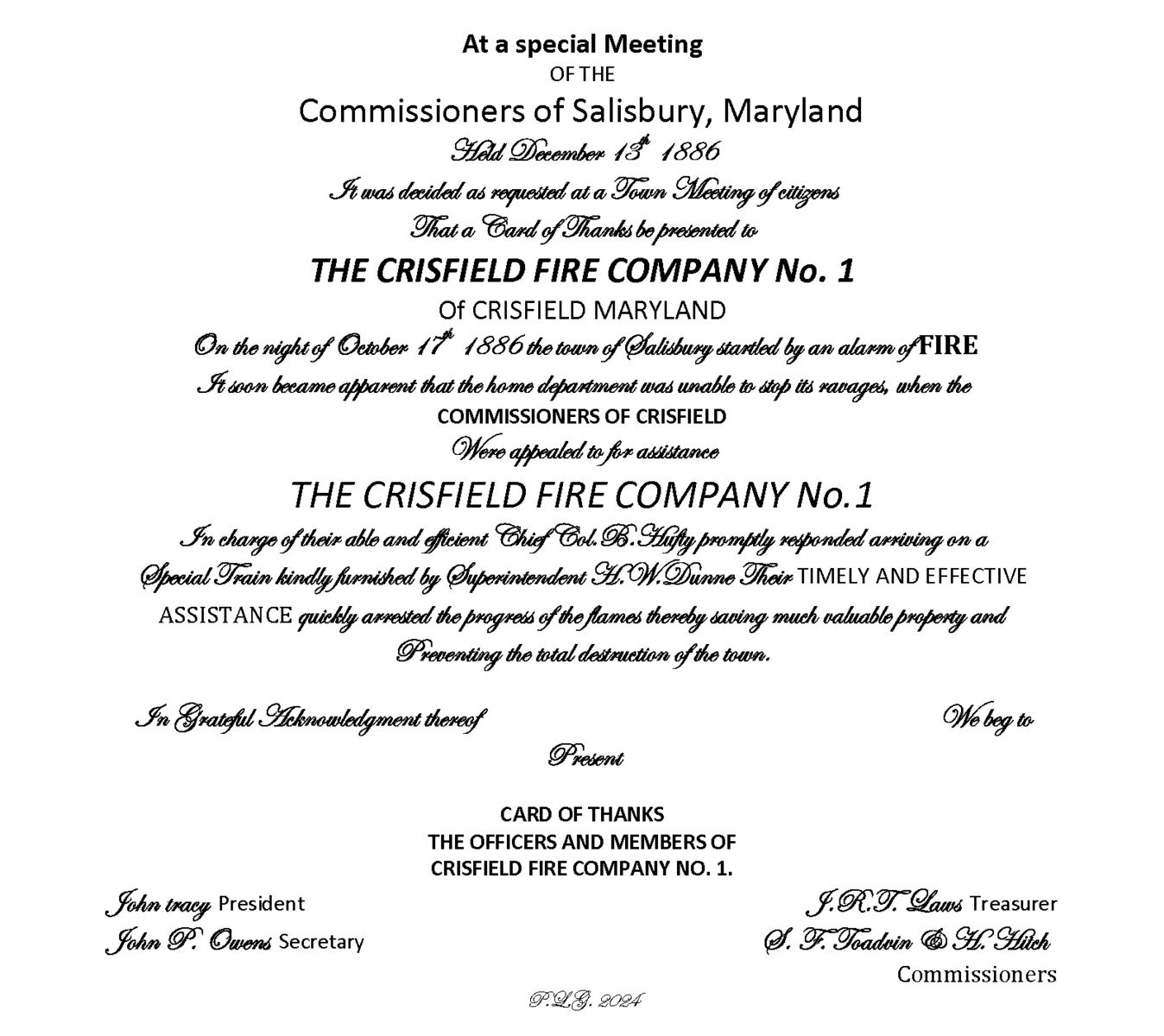
Only a short time after the steamer entered service, Crisfield was called to assist Salisbury during a devastating fire on October 17, 1886. The request came by telegraph, and the Crisfield firemen responded by special train with the steam engine. The pumper and crew reportedly arrived in Salisbury around 9 p.m., roughly 90 minutes after the request, an impressive response for the era. Among the Crisfield firemen identified in the history were Chief B. Hufty, Jeff D. Stubbins, James Purnell, and others. The steamer drafted water from Humphrey’s Pond and supplied water toward the newly constructed Wicomico County Courthouse, while members used soaked rugs, blankets, and sheets to help protect the roof from embers. Salisbury later presented Crisfield Fire Company No. 1 with a framed card of thanks, which remained preserved at the Crisfield fire hall as a reminder of early mutual aid and regional cooperation.
Water Supply, Alarm Systems, and Early Modernization
For years, Crisfield’s fire protection was limited by the availability of water. Before a developed municipal water system, firefighters relied on shallow wells, ponds, wells near the waterfront, and drafting from local waterways. The department’s history notes the importance of artesian wells and the development of a more dependable city water system, which became a major improvement not only for residents and businesses but also for fire protection.
The fire alarm system also evolved. Early alerts depended on a bell, a horse rider, and shouted warnings. Later, the ice plant’s steam whistle was used to alert the entire city. A fire code alarm system was developed using long and short blasts to indicate the district or area of town where members should respond. By the late 1920s, the whistle system was paired with a siren, and after telephone communication improved, an electric siren was mounted on the firehouse roof.
In 1900, the Clapp & Jones steam pumper was rebuilt by the American Fire Engine Company. In 1907, the department received its first fire hats. By 1909, the department had reorganized with about 33 members under Chief Rupert Somers, following a period when the company was reportedly disbanded and the city depended on a smaller group known as the “Kid Glove Gang.” That year, the city began paying firefighters $12 per year and $1 for each fire attended, while also assessing fines for missed alarms without a valid excuse. This system was later replaced by reductions in city taxes and water bills for qualifying members.
Motorized Firefighting and the Fifth Street Firehouse
The early twentieth century brought major change. The department moved into the motorized era on August 2, 1916, when Crisfield received its first self-propelled American LaFrance combination pumper and chemical unit at a cost of $5,500. The apparatus had a 75-horsepower, four-cylinder gasoline engine, solid rubber tires, and carried tools including lanterns, pike poles, and ladders.
This purchase changed how the department responded. Motorized apparatus improved speed, increased equipment capacity, and reduced dependence on horses and hand-drawn equipment. It also required new knowledge in operation, maintenance, and training. At the time, the firehouse was located on Fifth Street, in the rear of the Lyric or Majestic Theater area, and the company was beginning to take on the form of a more modern fire department.
The department faced a series of significant fires during this period, including fires in the Jersey Island area, the Nat Gates foundry and machine shop in 1917, Old Asbury Park in 1918, and Asbury Methodist Church in 1919. At the Asbury Church fire, the lack of water mains in the area greatly limited the department’s ability to control the blaze. That challenge would appear again in 1926, when Asbury Church suffered major damage after embers from a nearby garment factory fire reached the wooden roof. The later installation of a water main and the use of fire-resistant roof materials reflected hard lessons learned through fire loss.
Incorporation, Tradition, and the Broadway Firehouse
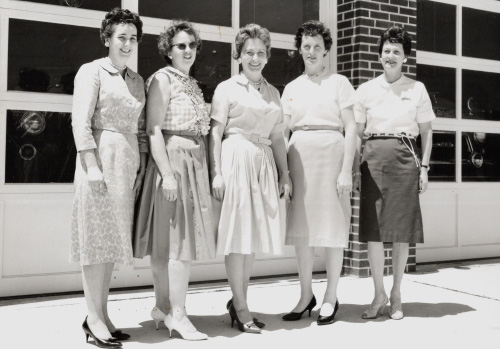
In 1921, the company was formally incorporated. The charter was published on February 18, 1921, and recorded in Somerset County and State of Maryland records on March 4, 1921. The company also had a band, held regular business meetings, and established a tradition of annual banquets and Ladies Night events. That tradition became part of the department’s identity and continued for more than a century.
In 1924, the City of Crisfield purchased another American LaFrance fire truck, a Model 75 with a 750-gallon-per-minute pump. That same year, the city built a new firehouse on Broadway near the city’s maintenance and water departments. The Broadway station was a two-story brick building with an engine room on the first floor and meeting space above. It included an electric fire siren connected to the telephone system, allowing telephone operators to receive fire calls and activate the siren. The Broadway station became the department’s third headquarters and served as an important home for apparatus, meetings, training, and community life.
The Great Fire of 1928
One of the defining events in Crisfield’s history occurred in March 1928, when a major fire broke out at the Odd Fellows Hall, later known as the Arcade Theater, at Main and Fourth Streets. Newspaper accounts described it as one of the most destructive fires the city had ever experienced. Ninety buildings reportedly burned, approximately 60 families were left homeless, and 66 firms were affected. The fire destroyed much of the retail shopping district and caused more than $1 million in damage.
The fire began in the theater’s projector room while hundreds of people were inside. The audience evacuated without panic, but the fire spread rapidly in heavy winds. Communications were soon compromised as telephone and telegraph lines were destroyed, and electric lines serving the city and water system were also affected. Firefighters moved engines to Cove Landing to draft saltwater from Somers Cove, and mutual-aid companies responded from Salisbury, Princess Anne, Pocomoke, Delmar, Laurel, and Seaford. The fire was brought under control after a long fight, aided by a shift in wind direction.
The 1928 fire demonstrated the importance of mutual aid, water supply, communication, apparatus capacity, and urban planning. After the disaster, city officials began planning to rebuild the business district with wider streets and improved infrastructure. For the fire department, the incident reinforced the need to continue modernizing equipment and strengthening response capability.
Mid-Century Apparatus and Wartime Service
In 1928, the city purchased another American LaFrance fire truck, and in 1940, the city purchased an International fire truck equipped with a booster reel, ladders, hose bed, and 500-gallon booster tank. This apparatus, marked Engine No. 4, was manufactured and supplied by the W.S. Darley Company.
World War II affected volunteer fire service in Crisfield as it did across the country. Many regular members entered military service, and the community trained auxiliary firefighters for civil defense. Classes were held to teach the proper handling of apparatus, hose, ladders, and equipment, as well as response to incendiary bombs and other wartime emergencies. B. Horace Ford, a former chief, served as an instructor, and Chief Stevenson called for the auxiliary ranks to grow.
In 1947, the department added a major piece of equipment: an American LaFrance aerial ladder truck. The truck was equipped with a 65-foot hydraulic aerial ladder and a fire pump. It improved the department’s ability to operate at larger buildings, reach elevated areas, and apply large streams of water from above. The aerial became a source of department pride and remained part of the company’s identity for decades.
The Push for a New Station
By the late 1950s, the Broadway firehouse was no longer adequate. The apparatus fleet had grown, the 65-foot aerial ladder required a full bay, and the building did not provide enough space for meetings, public activities, or the expanding needs of the company. In 1957, the company received a new GMC-based engine with a 750-gallon-per-minute multi-stage pump. Around that same period, the University of Maryland Fire Extension Service began providing modern fire and first-aid training to local fire companies, reflecting the increasing professionalization of volunteer firefighting.
In January 1959, newspaper coverage reported that the department was planning a new headquarters on Main Street. The new building was intended to house apparatus and provide a hall and dining room for banquets and public functions. The building committee included Robert Bradshaw, President; Clinton W. Dize, Chief; J. Wilbert Coulbourne, Treasurer; and members Jerry Hill, Hilton M. Dize, and Davis Horsey. The volunteers agreed to assume at least one-third of the project cost, with the City of Crisfield responsible for the remaining portion and ownership of the land and building.
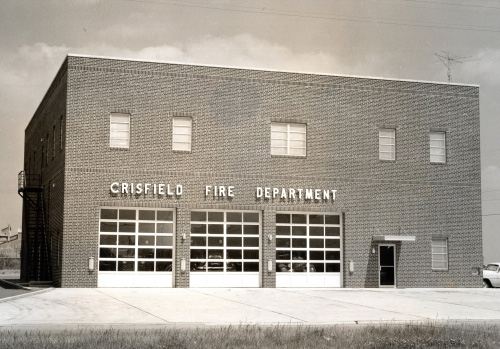
The planned building was a two-story masonry structure measuring approximately 70 by 80 feet. It was designed with an engine room capable of housing seven pieces of equipment, along with offices, lounge space, meeting areas, showers, restrooms, and a second-floor banquet hall. Construction preparations began in 1959, and fundraising included community appeals, carnivals, bake sales, and other efforts to meet the volunteers’ financial commitment.
The West Main Street station was formally celebrated in June 1961. It became the department’s modern home and a civic facility as well as a firehouse. Later records identify the company as Somerset County Station 2 at 600 West Main Street. Some records differ on the exact cost and build date, but the combined history supports the conclusion that the project was planned and financed beginning in 1959, built during the 1960–1961 period, and formally dedicated in 1961.
Service, Leadership, and Department Culture
The history of the Crisfield Volunteer Fire Department is also the history of its members. The records do not provide a complete year-by-year roster, but several long-serving leaders stand out.
J. Millard Tawes was a life member, a former Governor of Maryland, and a past president of the Maryland State Firemen’s Association for 1936–1937. He was credited with 52 years of service and delivered remarks at major department events. B. Horace Ford served more than 45 years, including 16 years as chief, and was also a past president of the Maryland State Firemen’s Association. John S. Holland served as chief for 10 years and had more than four decades of service. Grover C. Adams was remembered for 52 years of service and reportedly died after suffering a heart attack while performing duties at the Collins Street school fire. Clinton W. Dize served for decades and was credited in 1972 with 32 years of active service and 21 years as chief.
The department’s memorial traditions also reflect the importance of service and remembrance. The 150-year history includes a roll of deceased members read during annual memorial services and notes the department’s continuing practice of honoring those who have answered their last alarm.
Expansion of Equipment, Rescue Capability, and Training
During the 1950s, 1960s, and 1970s, the department continued to expand beyond traditional fire suppression. In 1951, the city and fire company pursued a GMC/American LaFrance pumper rated at 750 gallons per minute after concerns were raised by fire underwriters regarding outdated equipment. In 1956 and 1957, additional pumper capability was added. In 1965, the department acquired a Mack pumper rated at 1,250 gallons per minute, and in 1967, a 1,200-gallon tanker improved water supply operations outside hydranted areas. In 1970, the department placed into service a utility truck with lighting, smoke ejector, breathing equipment, salvage covers, and rescue tools.
The addition of breathing equipment, salvage equipment, lighting, rescue tools, and tankers reflected the department’s expanding mission. Firefighters were no longer responding only with hose and ladders. They were being called upon to provide rescue, lighting, ventilation support, water supply, and specialized service under increasingly complex conditions.
In 1972, the department installed a radio-controlled monitor alarm system by Plectron Corporation. Active members were issued home monitors, which were activated through the Crisfield Police Department. This system was a major change from bells, whistles, and sirens because it allowed firefighters to receive alarm information directly in their homes.
The department celebrated its 100th anniversary in 1974 during Fire Prevention Week. Events included a dance at the station, the Delmarva Firemen’s Convention in Crisfield, fire prevention activities, a public open house, and a Main Street parade featuring fire apparatus from across the peninsula. The centennial celebration connected the department’s history with public education and regional fire-service fellowship.
Mutual Aid and Regional Responsibility
Mutual aid has been part of the department’s identity since at least the 1886 Salisbury fire. Over time, cooperation with neighboring companies became a routine and essential part of operations. Crisfield has worked with Marion and other Somerset County companies, and the department’s modern role as Station 2 connects it to Somerset County’s wider emergency-services system.
Mutual aid is especially important in a rural and waterfront region. Large fires, waterfront incidents, school fires, storms, rescue calls, and water-supply needs can exceed the resources of any single company. The department’s history repeatedly shows the value of neighboring fire companies responding to Crisfield and Crisfield responding beyond its own immediate area when needed.
The Twenty-First Century Fire Service
As the department entered the twenty-first century, its mission continued to expand. Around 2004, under Chief Scott Ward’s administration, the department began using a command vehicle. The department’s history connects this development to the broader adoption of the Incident Command System, which provided a formal structure for managing emergency scenes. The chief or assigned officer could respond, establish command, report conditions to central alarm, and coordinate incoming units.
In 2005, the department replaced an aging aerial apparatus with a 1985 Simon/Duplex LTI 100-foot ladder tower from Concordville, Pennsylvania. Like many volunteer fire departments, Crisfield balanced operational need with the financial reality of purchasing and maintaining used specialized apparatus.
In 2012, the company focused on water supply for both the city and the outer portions of its response district. After researching options, members purchased a Pierce tanker-pumper demonstrator that became Tanker 2000. The truck cost $385,000 and was financed through a local bank. Its pump-and-roll capability and water supply function reflected the department’s need to operate effectively in both hydranted and non-hydranted areas.
Marine Response and the Waterfront Mission
Crisfield’s location has always shaped its emergency-service needs. The city’s waterfront, tidal flooding risk, boating activity, marina, seafood economy, low-lying geography, and exposure to coastal storms make marine response an essential part of public safety.
Fire and rescue boats became a newer addition to the department’s equipment inventory as Station 2 of Somerset County’s emergency system. The department first used smaller craft, including a Boston Whaler reportedly acquired through Maryland Department of Natural Resources surplus property. The mission included evacuating citizens during high water and later expanded to rescues of stranded boaters dispatched through Somerset Central 911.
In 2019, the department received a larger fiberglass boat donated by Chesapeake Boat Builders. David Mason, a member of Station 2 and owner of the company, donated the hull to Crisfield Fire Company. The vessel was built with a cabin and measured 28 feet long by 10 feet wide. The department spent approximately $56,000 to equip it with twin 250-horsepower Mercury outboard motors and other equipment. Normally docked at Somers Cove Marina, the boat carries a portable fire pump, making it a fire and rescue response unit.
Recent Apparatus and Continuing Adaptation
The department continued to adapt its apparatus fleet in the 2020s. When the 1985 Simon/Duplex ladder tower again became a maintenance concern, the company purchased a 1989 Pierce 105-foot tower from Indian River Volunteer Fire Company in Millsboro, Delaware, for $15,000. The apparatus had a self-leveling platform and master stream device, and as of December 31, 2023, it had returned to the station after hydraulic repairs and was ready to respond.
The 150-year history, finalized as of January 1, 2024, identifies Frankie Pruitt as the current chief for the 2010–2024 period and includes a list of past chiefs ranging from Chief B. Hufty in 1886 through modern leadership.
Community Institution and Civic Anchor
The Crisfield Volunteer Fire Department has always been more than an emergency-response agency. Its firehouses have served as meeting places, fundraising centers, banquet halls, public gathering spaces, and symbols of community identity. The department and its Ladies Auxiliary have been associated with banquets, dances, rummage sales, service awards, public events, fire prevention activities, Christmas decorations, blood-pressure screenings, memorial services, and community support.
This civic role is a defining feature of volunteer fire departments in small communities. Crisfield’s firefighters have not been strangers arriving from outside the community; they have been neighbors, family members, coworkers, watermen, business owners, retirees, young volunteers, and community leaders. Their service has depended not only on responding to alarms but also on raising funds, maintaining equipment, training, attending meetings, supporting families, and preserving traditions.
Challenges, Change, and the Future
A department with more than 150 years of history has also faced change and challenge. The historical record includes periods of limited resources, inadequate facilities, water-supply challenges, major fires, financial obligations, modernization needs, recruitment demands, and changing expectations for volunteer emergency services. One modern controversy involved a gender-discrimination lawsuit related to membership denials in 2008 and 2009. The record notes that Nicki Powell became the department’s first female member in March 2011, and that the court ultimately granted summary judgment for the department and individual defendants while advising the adoption of objective qualifications and publicly announced admissions periods. This episode reflects the broader evolution of volunteer fire service toward more formal governance, transparency, equal opportunity, and accountability.
Looking ahead, the department’s future includes the same pressures faced by many volunteer fire companies: recruitment, funding, training requirements, apparatus costs, facility needs, EMS coordination, marine response, storm readiness, and climate resilience. Recent planning has identified a proposed replacement fire station and emergency shelter tied to Crisfield’s broader public-safety and resilience needs. In a low-lying waterfront community, a fire station is not only a place to house apparatus; it can serve as a command post, staging area, shelter, resource hub, and center of continuity during emergencies.
A Legacy of Neighbors Protecting Neighbors
From the earliest fire brigade in 1874 to Somerset County Station 2 in the modern emergency-services system, the Crisfield Volunteer Fire Department has remained rooted in the same basic mission: neighbors protecting neighbors. Its history includes the bucket brigade, the Clapp & Jones steamer, the great fires of 1883 and 1928, the move to motorized apparatus, the Broadway firehouse, the West Main Street station, wartime auxiliary training, aerial apparatus, tankers, command vehicles, rescue boats, public education, and generations of members who gave their time to protect the community.
The department’s story is not simply about trucks, stations, or fires. It is about a community that repeatedly recognized a need and responded. It adapted after major fires. It improved water supply. It modernized apparatus. It built larger stations. It developed mutual-aid relationships. It expanded into rescue, command, and marine response. It honored its members and preserved its traditions. Through economic change, storms, fires, and the evolution of the modern fire service, the Crisfield Volunteer Fire Department has remained one of the city’s essential institutions.
For more than 150 years, its members have protected homes, businesses, churches, schools, waterfront properties, roadways, and waterways. They have stood watch over a city shaped by the water and sustained by community spirit. The tools have changed, the apparatus has changed, and the expectations placed on volunteers have grown, but the central purpose remains the same as it was in 1874: service to Crisfield and protection of its people.
 |
 |
 |
 |
 |
 |
